
Genixly team
-
March 24, 2026
Guide to Routing Quality in GEO: Don’t Let AI Send Buyers to Amazon Instead of You
Lear more

SEO vs. GEO is the new visibility battlefield. Discover the key differences between searching and asking, traffic and authority, and dual-optimization in 2026.



For over two decades, the formula for digital visibility was absolute: target keywords, build backlinks, and earn a spot in the ten blue links. But that era is ending. With the rapid adoption of AI-driven platforms like ChatGPT, Perplexity, and Google’s AI Overviews, user behavior is fundamentally shifting from searching for resources to asking for solutions. This transition has birthed a new, critical discipline: Generative Engine Optimization (GEO).
While traditional SEO (Search Engine Optimization) competes for clicks by optimizing for a retrieval algorithm, GEO competes for citations by optimizing for a reasoning engine. One relies on link popularity and metadata; the other demands structural clarity and verifiable authority. The core question for brands in 2026 is no longer just "How do I rank #1?" but "How do I become the AI's trusted Source of Truth?"
However, this shift does not mean SEO is dead. It means it is no longer enough. To survive the transition from the index to the inference layer, brands must master a "Dual-Optimization Stack." In this guide, we break down the mechanical differences between SEO vs. GEO, explore why the "messy middle" of search is collapsing, and provide a strategic blueprint for optimizing your content to be found by humans and cited by machines.
To understand the future of digital visibility, we must first distinguish between the engine of the past and the engine of the future.
Search Engine Optimization (SEO) is the established practice of improving how webpages rank on traditional search engines like Google and Bing. Fundamentally, SEO is index-based. It relies on specific signals, such as keywords, backlinks, page structure, and domain authority, to determine which URLs appear in a ranked list.
In the SEO era, success is defined by ranking. The goal is to earn a position (ideally the top spot) in a list of ten blue links, encouraging the user to click through to a destination website. SEO competes for traffic.
Generative Engine Optimization (GEO) is the emerging discipline of optimizing content so that AI systems — including ChatGPT, Perplexity, Gemini, and AI Overviews — can ingest, understand, and cite your information.
Unlike traditional search, GEO is inference-based. Generative engines do not just retrieve links; they interpret meaning, match semantic vectors, and synthesize comprehensive answers. Success in GEO is defined by citation. The goal is not just to be listed, but to be the source the AI uses to construct its answer. GEO competes for authority.
The core distinction between the two lies in the mechanism of discovery:
This shift represents a fundamental change in user behavior. Users are moving from "searching" (looking for a list of resources) to "asking" (expecting a direct answer). This transition is why brands can no longer rely on SEO alone; they must optimize for the machine that answers the question. But before going any further, let’s say a few words about the transition itself.
For most of the internet era, users interacted with search engines like they were librarians: they issued short, literal keywords and dug through pages of results to find what they needed. But that behavior is collapsing.
The shift began the moment AI systems started interpreting full sentences rather than fragmented keywords. Users are no longer looking for pages — they are looking for answers. This shift is accelerating; Gartner predicts that in 2026, traditional search volume will drop by 25% as users migrate to AI chatbots.
Consider the difference in query complexity:
This is not a search query; it is a problem statement.
Problem statements demand synthesis, ranking, context, and judgment — all in a single response. When users switch from "searching" (hunting for resources) to "asking" (demanding a solution), the search engine must evolve from a directory into a consultant. And that’s exactly what has happened to Google, which still offers its traditional list of ten blue links but displays the AI-aggregated response above this list.
Generative engines fundamentally change the user journey by collapsing the "messy middle."
In traditional SEO, the user had to navigate a chaotic mix of comparison tables, listicles, reviews, Reddit threads, and pros-and-cons pages to form an opinion. Now, the AI does the navigating. It reads the entire corpus of data, weighs the evidence, resolves contradictions between sources, and answers directly.
The user receives the conclusion without performing the investigation. Data from SparkToro indicates that nearly 60% of searches are now 'zero-click,' meaning the user never leaves the search results page. This means the traffic that used to flow to "comparison" sites is now being satisfied directly on the search results page (SERP) or within the chat interface.
This shift is why GEO is critical for 2026. When the user sees only the final synthesis, visibility no longer depends on how well you rank in a list of blue links. It depends on trust.
Success now relies on how well a machine can:
In a world where the AI creates the final answer, the content that gets chosen — not merely the content that gets indexed — becomes the only content that matters. Follow this link to learn more about why GEO is important.
This new reality leads directly to the next logical question: If AI is doing the choosing, how exactly does it decide what to cite?
Behind the shift from SEO to GEO lies a big structural change in how information is evaluated. Traditional search engines rely on explicit signals — keywords, links, and metadata — to determine relevance. AI models, however, operate on meaning.
They analyze relationships, context, probability, and semantic consistency. Understanding this distinction is essential because it explains why content that performs well in classical search (high keyword density) often fails completely in AI-driven discovery (low semantic value).
Traditional search engines follow a linear, mechanical process. In the SEO framework, discovery is a retrieval problem. The engine’s goal is to fetch documents that match the query string.
The process relies on specific heuristics to assign a ranking score:
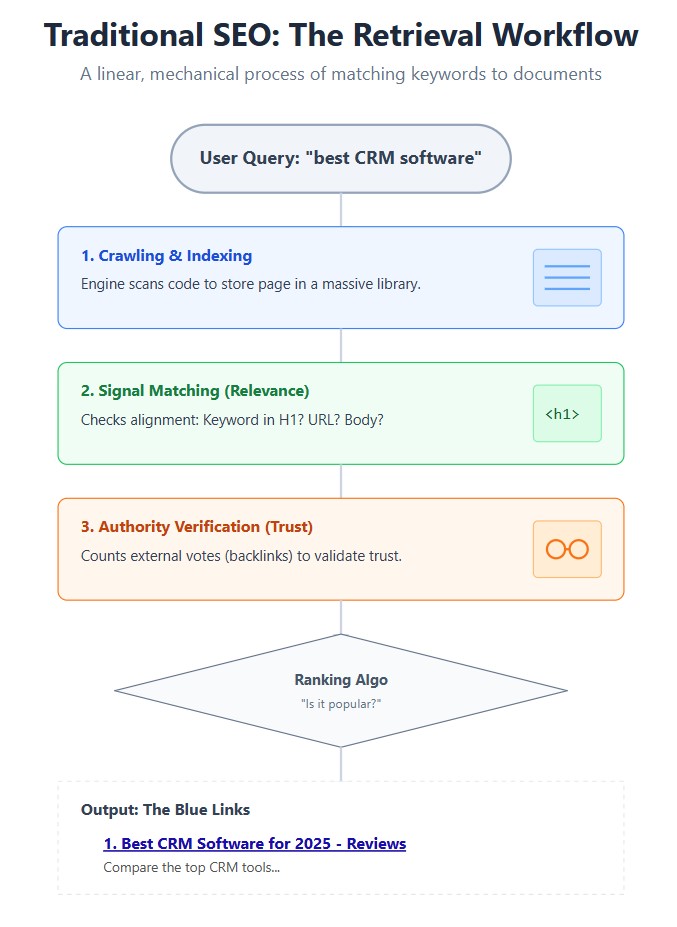
In this model, visibility is a hierarchy of blue links. Because humans click links rather than reading code, the system optimizes for Click-Through Rate (CTR). It asks: “Is this page popular enough to show at position #1?”
Generative engines operate on a completely different layer. They do not just index the web; they interpret it. In the GEO framework, discovery is a reasoning problem.
Instead of matching keywords, AI models ingest content into vector space — a multidimensional map of meaning where concepts are related by distance, not just exact wording.
Here is how the GEO process differs:
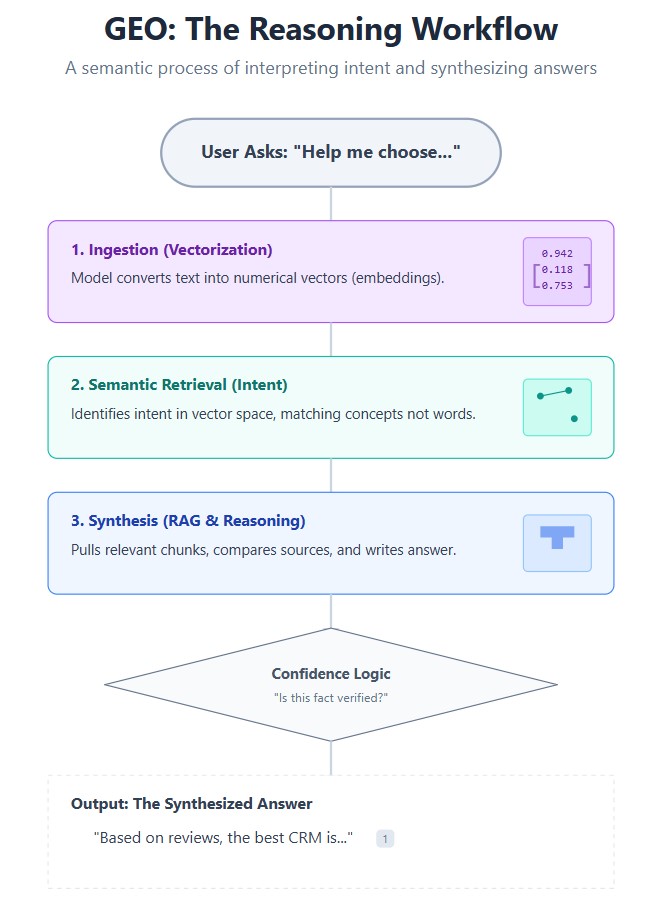
In GEO, your content is not competing for a page position; it is competing for inclusion. You are vying for the right to become a sentence, a statistic, or an explanation inside the final output. The model does not care about your click probability; it rewards confidence scores and structured clarity.
The Bottom Line: SEO optimizes for the crawler that indexes the page. GEO optimizes for the model that understands the concept.
While SEO and GEO share the ultimate goal of visibility, they achieve it through fundamentally different mechanisms. The following table breaks down the technical and strategic shifts between the two frameworks.
As we’ve already mentioned, generative engines do not “rank” pages; they select sources to synthesize. To ensure your content is chosen for inclusion, you need to move beyond basic keywords and optimize for Model Confidence based on these 9 pillars of a successful GEO strategy:
Deep Dive: These pillars represent a complete shift in how we architect content. Read our full guide here to learn more about each step: The 9 Pillars of Generative Engine Optimization explained in detail.
The rise of generative engines has sparked a tempting but misleading question: Is good SEO good GEO?
The answer is no.
Will GEO replace SEO?
Also no, not because SEO remains unchanged, but because the modern visibility landscape now requires two complementary systems working in parallel. We call this the Dual-Optimization Stack. It reflects the reality of user behavior in 2026: sometimes we browse, and sometimes we ask.
Traditional search remains the dominant framework for action-oriented queries. Users still need to navigate to specific destinations to perform tasks.
In these scenarios, SEO is uniquely positioned to capture high-intent traffic. Technical health, backlink profiles, and page speed continue to determine who appears at the top of the blue links. SEO remains the discovery layer for users who need to visit a site to get what they want.
GEO dominates where the real shift is happening: complex problem solving.
AI-driven queries collapse the marketing funnel into a single request. Instead of searching for "B2B commerce platforms" and reading ten reviews, a user asks: “Find me the best platform for B2B commerce with multi-store support and SAP integration.”
These tasks never hit a traditional SERP; they are answered upstream, inside a model’s inference layer.
The "Stack" approach works because the two strategies are symbiotic rather than competitive. One drives traffic; the other drives inclusion.
Ultimately, the dual-optimization stack solves for two different outcomes:
Brands that master both layers simultaneously are the only ones that will remain visible as the boundary between "searching" and "asking" continues to collapse.
GEO does not affect every industry equally. The shift from “searching” to “asking” reshapes discovery depending on the complexity of the decision and the "reasoning gap" required to answer it.
Some industries experience GEO as a simple efficiency boost; others experience it as a complete rewiring of their acquisition funnel. Understanding these differences is essential because GEO is not a single tactic — it is a new layer of competition that expresses itself uniquely in each sector.
Ecommerce is experiencing the most dramatic shift. Traditional SEO drove shoppers through a linear, mechanical funnel: Keyword Search → Category Page → Filter Selection → Product Page.
Generative engines collapse this journey into a single Constraint-Based Query.

As the screenshot above demonstrates, the AI has fundamentally changed the role of the search bar. Notice that the user did not navigate to a retailer; the "shopping" happened entirely inside the inference layer. The model didn't just match keywords; it performed cross-entity reasoning. It had to understand the dimensions of a "Mini Cooper trunk" (Entity A), cross-reference that against the folded dimensions of various stroller models (Entity B), and filter the results by price and logistics data (Entities C and D).
This visual proves that the "messy middle" of the purchase journey is disappearing. The AI has already done the heavy lifting of reading reviews, checking specs, and verifying availability. The products that appear in this chat window aren't necessarily the ones with the most backlinks — they are the ones with the most structured, accessible attributes.
In this scenario, the model performs the comparison, not the customer. GEO determines whether your product is even considered based on attribute visibility. If your product page lists dimensions in a PDF but not in structured schema, the AI cannot "fit it in the trunk." Brands that fail to provide machine-readable certainty regarding specs and use cases vanish from the recommendation layer.
Follow this link to learn more about GEO in ecommerce. Also, don’t miss our selection of the best GEO tools for ecommerce.
For publishers, the shift is existential. Traditional SEO rewarded long-form content designed to keep users on-page (dwell time). AI engines, however, reward conciseness and extraction.

In the example above, notice that the AI did not summarize the entire history of fasting. It scanned thousands of pages to find a specific "Claim-Proof" pair. One publisher won the citation not because they wrote the longest article, but because they structured their answer as a direct fact: "Studies show cortisol levels can increase by X% during the initial fasting window."
This illustrates the "zero-click" reality. The user’s intent was satisfied without visiting the website. However, because that specific publisher provided the "Source of Truth" in a machine-readable format, they earned the citation. This builds brand authority and drives high-intent traffic from users who click the citation number to verify the data.
GEO transforms publishing into a game of Citation Capture. The goal is no longer just pageview accumulation, but becoming the authoritative source that the AI credits. Publishers must adapt by structuring content logically — using clear definitions, data tables, and "quotable segments" — making it easy for the model to "chunk" and cite their work rather than synthesizing a generic answer from competitors.
Local SEO has historically relied on proximity and categories ("Coffee shop near me"). Generative engines reshape this by evaluating Contextual Vibe.
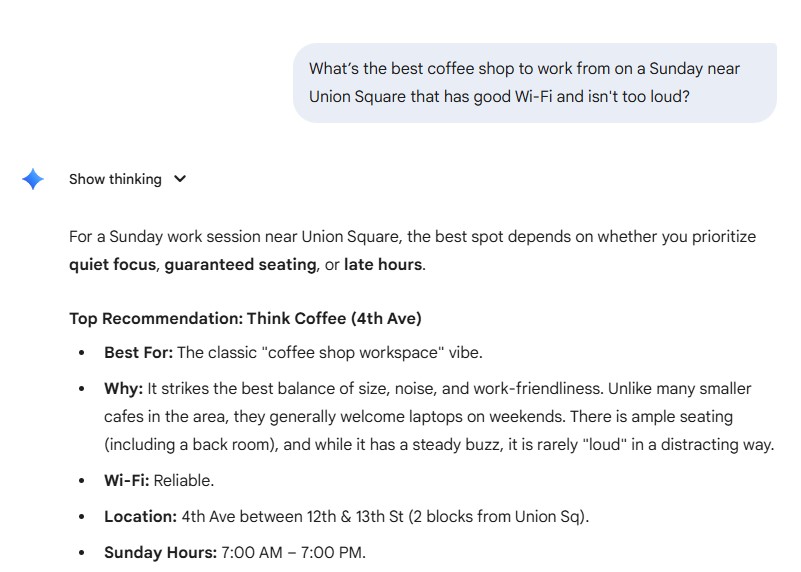
The screenshot above reveals a critical change in local discovery. The model is not just looking for a location pin; it is performing Sentiment Analysis on thousands of unstructured reviews. It had to read the text of customer feedback to determine "loudness" and "Wi-Fi reliability" — data points that don't exist in standard business directories.
This proves that for local businesses, visibility is no longer just about NAP (Name, Address, Phone). It is about optimizing your Narrative. The business in the example won the recommendation not because it was the closest to the center of Union Square, but because its review corpus contained the highest frequency of semantic matches for "work," "quiet," and "Sunday."
For local businesses, GEO requires a shift from optimizing listings to optimizing experiences. You ensure visibility by encouraging reviews that mention specific attributes ("great for working," "quiet atmosphere") so the AI can match your business to specific user needs, not just geographic coordinates. Now, follow this link to learn How to Measure GEO Success in Ecommerce.
The shift from SEO to GEO is already happening. Visibility is now determined long before a user reaches your site. It begins inside the AI's reasoning layer, where content is parsed, validated, and chosen.
To thrive in 2026, brands must treat GEO as infrastructure, not a campaign. This means building content that is machine-readable by default while maintaining the technical SEO needed for traditional search. The future belongs to those who optimize for both: SEO to get found, GEO to get chosen, and, what’s most important, people to read. Understanding the difference is step one; step two is execution. Learn exactly how to make the switch from search to synthesis in our guide on how to get started with GEO.
Our blog offers valuable information on financial management, industry trends, and how to make the most of our platform.



.jpg)


