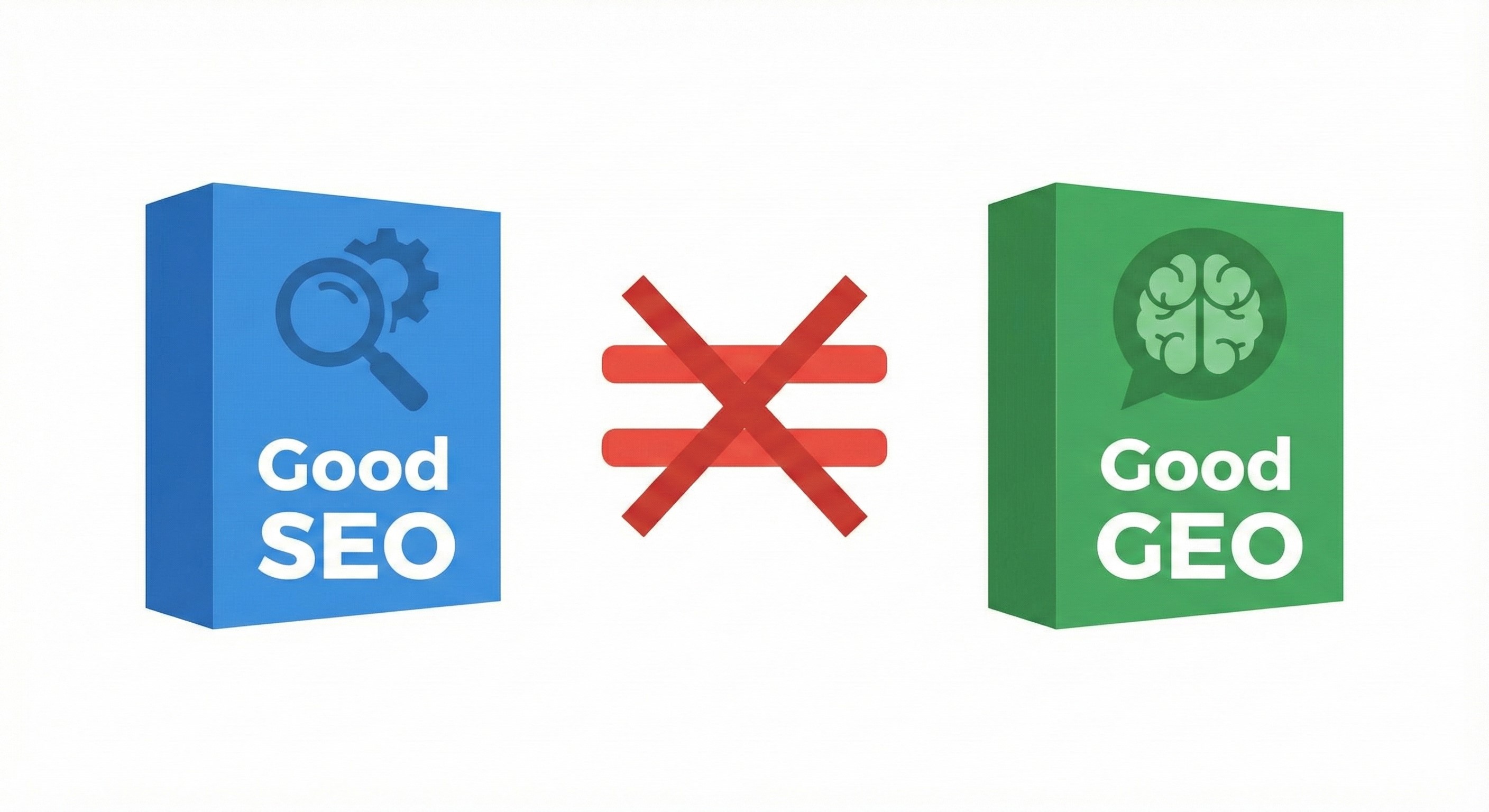
Why "Good SEO is Good GEO" is a Dangerous Myth: The Reality of Optimization in the AI Era
Google claims "Good SEO is Good GEO," but we disagree. Learn why purchased backlinks and keyword stuffing hurt AI visibility and Generative Optimization.
Google’s Search Liaison, Danny Sullivan, recently declared that "Good SEO is good GEO." It is a comforting sentiment, meant to reassure marketers that their decades of accumulated knowledge are still perfectly applicable in the age of Artificial Intelligence.
While there is a kernel of truth to this in a utopian sense, we fundamentally disagree.
Equating Search Engine Optimization (SEO) with Generative Engine Optimization (GEO) is not just inaccurate — it is delusional and potentially harmful to your brand’s visibility. Below, we explore why "working" SEO often actively works against GEO, and how much overlap between SEO and GEO truly exists.
The "Working" SEO Trap: Optimization Over Substance
To understand the conflict, we must look at how traditional search engines select winners. For years, Google’s algorithms have prioritized optimized content over potentially good content.
If your content is the most insightful in the industry but lacks specific optimization, you may not appear even on the second page. Conversely, mediocre content often ranks #1 because it plays the game better.
The Game of (Thrones) Traditional SEO
In the current landscape, "Good SEO" often means manipulating the system rather than serving the user. This involves:
Aggressive Keyword Insertion: Forcing specific phrases into places they don't naturally fit. You’ve seen this. A sentence reads, "If you are looking for ‘best plumber New York cheap price’, we are here." It sounds like a broken robot, but Google’s crawler loves the exact match, so it ranks.
Purchased Backlinks: artificially inflating authority. A massive SaaS company pays a broker to get a link on a random "Mom & Pop Gardening" blog. The link to their project management software is hidden in a paragraph about tomatoes. It makes zero semantic sense, but the "link juice" passes, and their domain authority grows.
Chaotic Internal Linking: Using exact-match anchor text regardless of context. You link the word "apple" (referring to the fruit in a diet article) to a category page for Apple Smartphones. You do this unintentionally because your new plugin does this automatically, trying to pass as much power to the tech page as possible. It confuses the user, but it works for the crawler.
Weaponized "Negative" SEO: The system is so reliant on signals that it can be used as a weapon. Imagine you write a great article that hits #1. A competitor with a bigger budget doesn't just try to outrank you; they pay for thousands of "toxic" backlinks (like from gambling or adult sites) to point at your article. Google sees the spam, assumes you are cheating, and penalizes you. You disappear from the results without doing anything wrong.
In the game of traditional SEO, algorithms are rigid filters. This lack of advanced semantic understanding made it easy for bigger market players to win simply by having the budget to hire a marketing team, purchase extensions, buy backlinks, and mathematically force their way to the top of the SERP.
How GEO Breaks the Corrupted Cycle of Content
Luckily, Generative Engine Optimization is not like that. It operates on a completely different framework. AI models do not count backlinks or keyword density; they analyze semantic logic and trust.
The tactics that still define the working SEO often act as poison for AI models.
The Hallucination Problem
Let's revisit the "Apple" example.
In SEO: Linking "apple" (fruit) to "Apple" (iPhone) is a clever equity-passing trick.
In GEO: This is a semantic contradiction. When an AI analyzes your site structure to formulate an answer, it sees a link connecting a biological fruit to a consumer electronic. The AI gets confused. To avoid "hallucinating" (providing false info), it simply chooses not to cite you.
Ideal vs. Reality
The good news is that"good SEO" still means purely organic backlinks, perfectly semantic anchor text, and natural language.
The bad news is that this ideal world doesn't exist. If you play by "ideal" rules, you lose to competitors using "working" rules (aggressive optimization).
This is where the phrase "Good SEO is Good GEO" falls apart.
AI is sophisticated. It analyzes content for novelty and logic rather than the depth of technical optimization. It breaks the cycle where the biggest budget wins, leveling the playing field for those with genuine expertise.
Information Gain: Why Skyscrapers Fall in GEO
What has been the golden rule of SEO for the last decade? "Create better content." In practice, however, this usually meant the "Skyscraper Technique": take the top 3 ranking articles, rewrite them, combine their points, and publish a "new" article.
Result: A unique string of words that offers zero new value.
SEO Outcome: You rank because the content is more "comprehensive" than the three articles it is based on.
The Thesaurus Trap
In the AI era, the definition of "unique" has shifted dramatically. Rewriting existing ideas using different words is what we call the Thesaurus Trap.
Large Language Models (LLMs) are trained on the entire internet. If your article merely repeats what is already in their training data (even if rewritten), the AI has no reason to cite you. It already "knows" that information.
GEO requires Information Gain. To be cited by AI, you must provide something semantically unique — data, opinions, or angles that none of your competitors are writing about. AI is smart enough to detect a rewrite and decline it. It seeks the source of the new idea, not the aggregator.
However, a shifting definition of what is truly 'unique' is just the first crack in the foundation. The argument that "Good SEO is Good GEO" truly unravels when we move from content strategies to the technical execution.
Tactical Divergence: Where GEO is Not SEO
To prove that GEO and SEO are different disciplines, let’s look at the tactics they use. The structural requirements for a Large Language Model (LLM) often directly contradict the best practices for a search crawler.
Consider the rigid constraints of metadata. For years, SEO specialists have been trained to treat meta descriptions like haikus, strictly keeping titles under 60 characters and descriptions under 160 to prevent truncation in Google’s search snippets. The goal was visual cleanliness and Click-Through Rate (CTR).
Generative Engines, however, don't just scan the visual snippet; they read the underlying code. In the world of GEO, those short, punchy descriptions often fail to give the AI enough context to determine if your content is the authoritative answer.
To win in GEO, you need descriptive, context-heavy metadata that explains the substance of the page — a practice that traditional SEO would flag as "too long."
The same divergence applies to headings. The "best" SEO practice dictates that you insert high-volume keywords into your H2s and H3s based on data from tools like Ahrefs or Semrush.
But GEO requires you to ignore the search volume and focus on the conversation. Real people ask AI complex, nuanced questions. Your headings should mirror these natural language queries to bridge the gap between user intent and AI comprehension, even if traditional keyword tools show those phrases have "zero search volume."
And this is only the tip of the iceberg. To fully illustrate why "working" SEO and "working" GEO are fundamentally different disciplines, we’ve broken down the key technical practices side-by-side below.
How Much Overlap Between SEO and GEO: Side-by-Side Comparison
Feature
"Good" SEO Practice
"Good" GEO Practice
The Conflict
Backlinks
SEO Practice
Focus on Quantity and Domain Authority (often purchased).
GEO Practice
Focus on Contextual Relevance and Citation Authority.
The Conflict
AI ignores "juicy" but irrelevant links that SEO relies on for ranking power.
Keywords
SEO Practice
Exact match, high density, placed in headers and first 100 words.
GEO Practice
Natural Language Processing (NLP), semantic entities, and LSI.
The Conflict
AI views keyword stuffing as low-quality noise and lowers trust scores.
Length
SEO Practice
Long-form content (often fluff) to signal "comprehensiveness" to crawlers.
GEO Practice
Concise, answer-first formatting (BLUF: Bottom Line Up Front).
The Conflict
AI prefers direct answers; SEO encourages burying the lead.
Content Source
SEO Practice
Aggregated/Rewritten from top competitors (Skyscraper technique).
GEO Practice
Original data, unique opinion, new statistics (Information Gain).
The Conflict
AI filters out rewrites as redundant data (Thesaurus Trap).
Internal Linking
SEO Practice
Exact-match anchor text to pass "link equity" to money pages.
GEO Practice
Logical, topical clustering to help AI understand relationships.
The Conflict
SEO linking often creates semantic contradictions (e.g. fruit to phone) that confuse AI.
Schema Markup
SEO Practice
Used primarily for visual Rich Snippets (Stars, Price) to boost CTR.
GEO Practice
Used to define Entities and relationships (Knowledge Graph connection).
The Conflict
SEO uses Schema to decorate the result; GEO uses it to explain the concept.
Image Alt Text
SEO Practice
Used as a hidden place to stuff extra keywords.
GEO Practice
Used to accurately describe the image for multimodal AI analysis.
The Conflict
AI "sees" the image; if the text doesn't match the pixels, credibility drops.
Tone & Voice
SEO Practice
Neutral, "safe," and objective to appeal to the widest mass audience.
GEO Practice
Authoritative, opinionated, and high-perplexity (human-sounding).
The Conflict
AI treats generic content as "average" background noise; it cites unique voices.
Freshness
SEO Practice
Changing the "Last Updated" date and tweaking 5% of the text.
GEO Practice
Adding new facts, data points, or developments.
The Conflict
AI detects superficial updates and recognizes the core information hasn't changed.
We are entering a hybrid era. Your customers function non-linearly. They may start a search in ChatGPT to get a summary, and then go to Google to verify a specific product or price.
The New Reality: "Good SEO is not Good GEO" and will never be. SEO and GEO will coexist, but they serve different masters.
While some specialists predict SEO will become a legacy practice, we believe both remain vital. However, if you want to future-proof your business, you must shift your primary focus to GEO.
Winning on Google while remaining invisible on ChatGPT is a hollow victory. But why is this loss of visibility so important, even if we accept that AI answers often yield zero traffic to your site? You can explore the hidden value behind this phenomenon here: The End of the "Messy Middle".
Final Words: "Good SEO is not Good GEO"
It is time to stop pretending that optimizing for a 20-year-old crawler is the same as optimizing for a modern neural network. The mantra "Good SEO is Good GEO" is not just a simplification — it is a fallacy.
Think of the fundamental difference in the objective:
SEO is a popularity contest. It is about convincing a robot that your page is important because others are pointing at it. It relies on external signals and rigid formatting.
GEO is a credibility test. It is about convincing a synthetic intelligence that your content is the answer. It relies on semantic trust, logical structure, and pure information gain.
Now that we’ve debunked the myths that are holding you back, learn the actual steps to build a strategy that works in our guide on how to get started with GEO. However, trying to do everything manually — satisfying the rigid technical rules of the past while meeting the high-context demands of the future — is an overwhelming challenge that breaks traditional marketing teams.
To succeed, you need to automate the heavy lifting of these complex workflows. This is where Genixly comes in.
Genixly is the AI-native control plane for ecommerce. It allows you to automate not just your GEO strategies, but your entire workflow, ensuring you stay visible in both the ten blue links and the generative answers of the future.
It is not a lie, but it is a delusion. It assumes an ideal world where SEO is purely about quality. In reality, much “working” SEO relies on tactics like keyword density and link schemes that AI models often reject as low-quality noise. While the philosophies overlap, the tactics frequently conflict.
How much overlap actually exists between SEO and GEO?
The overlap is mostly structural. Both require a fast site, a clear sitemap, and mobile responsiveness. Beyond infrastructure, the overlap shrinks dramatically. SEO focuses on signals; GEO focuses on substance.
Why do my SEO-optimized articles fail in ChatGPT?
They are often caught in the “Thesaurus Trap.” If an article simply rewrites the top Google results — a common SEO tactic — AI treats it as redundant. Models prioritize Information Gain: new data, unique perspectives, and original insights, not rehashed keywords.
Do backlinks help with GEO?
Not in the traditional sense. SEO values link equity, often ignoring context. GEO values contextual citation. A high-authority link without semantic relevance may be ignored or even confuse the AI about your topic, reducing your chances of being cited.
Can aggressive keyword optimization hurt my GEO efforts?
Yes. Keyword stuffing that works for crawlers often reads as unnatural to humans — and to AI. When sentences feel forced or robotic, models lower the content’s trust score and are less likely to cite it as an answer.
What is the difference between optimization for Google and optimization for AI?
SEO optimization focuses on metadata, keywords, and popularity — convincing a ranking system you are relevant. GEO optimization focuses on entities and relationships — convincing an intelligence you are accurate. SEO plays the ranking game; GEO feeds the knowledge graph.
Is the “Skyscraper Technique” dead for GEO?
For GEO, yes. Skyscraper content prioritizes length. AI prefers clarity and directness (BLUF — Bottom Line Up Front). If the answer is buried under thousands of words added only to satisfy SEO length targets, AI may skip the page entirely.
Why does internal linking matter so much for GEO?
In SEO, internal links pass authority. In GEO, they define meaning. Linking “Apple” (the fruit) to a page about iPhones creates a semantic contradiction. Such inconsistencies confuse AI models, increasing hallucination risk or causing your site to be discarded as unreliable.
Should I stop doing SEO and focus only on GEO?
No. We are in a hybrid era. Users may ask an AI for answers and then verify them via search. You need a dual strategy. However, because GEO rewards genuine expertise over gaming tactics, prioritizing GEO often improves overall content quality, while SEO alone risks future invisibility.
Why is “zero-click” visibility important if I don’t get traffic?
In the AI era, being the answer is the branding. If an AI responds to “What is the best CRM?” with your brand, you have captured mindshare — even without a click. If you are absent from the answer, you are absent from the consideration set entirely.
Blog
Lasted Article
Our blog offers valuable information on financial management, industry trends, and how to make the most of our platform.