Genixly team
-
May 27, 2026
EU AI Compliance Guide: Building AI Apps Under the EU AI Act and GDPR
Lear more

Discover what GEO strategy is, why it matters, and how to build a GEO strategy that gets your brand cited by AI models like ChatGPT, Gemini, and Perplexity.


Below, we are going to guide you through the realm of a GEO strategy. The era of chasing ten blue links is ending. Today, users are asking complex questions and expecting synthesized, accurate answers, not just a list of websites. In this new landscape, visibility isn't about ranking #1. It’s about being the single, trusted source of truth that an AI model chooses to quote. And that’ exactly where GEO comes in handy.
This guide creates the blueprint for a successful GEO strategy, showing you how to shift your focus from optimizing for keywords to optimizing for entities. By structuring your data and building "moats" of proprietary information, you ensure your brand isn't just found by machines, but understood, trusted, and cited by them. If this deep dive feels too advanced or you need a refresher on the core concepts first, we recommend starting with our fundamental article on how to get started with GEO.
Everyone is talking about AI today. Whether you call it the next big bubble and scam or a new industrial revolution, the fact remains: AI is omnipresent. It has already fundamentally changed the status quo, and this is just the beginning.
In this new landscape, businesses are increasingly discussing GEO, or Generative Engine Optimization, and corresponding strategies. Let’s break this down.
But why is everyone so obsessed with ensuring AI models 'know' who they are? Simply put, it is the new frontier of online visibility. No business can afford to lose its digital presence in this shift.
AI has fundamentally changed the anatomy of a search query. And you’ve probably experienced this shift as a user when typing something on Google and seeing an AI-generated response or asking a chat assistant to recommend an item that perfectly fits your demands.
So, you won’t be surprised by the fact that people are no longer just typing keywords and scanning ten blue links. Instead, they are asking complex questions and expecting synthesized, accurate answers.
According to McKinsey, 44% of users who have tried AI-powered search now consider it their "primary and preferred" source for information. And it’s not surprising: AI makes search faster, more precise, and convenient.
In this new environment, visibility isn't about ranking. It's rapidly extending its borders to a new realm — the realm where being cited is everything. And a GEO (Generative Engine Optimization) strategy is your new playbook that ensures your brand is the source of that answer, rather than the noise behind it.
In practical terms, GEO shifts your marketing objective from "visibility" to "legibility."
This shift requires a move away from persuasion and toward clarity. AI models do not "read" like humans; they process patterns in data. If your brand information is contradictory, buried in fluff, or unstructured, the model will hallucinate or ignore you. A successful GEO strategy eliminates ambiguity, making it easy for the machine to trust your data.
It is a mistake to view GEO as simply "new SEO." They function on different mechanics and require different inputs.
Furthermore, the data behind the shift (from Princeton University) shows that while traditional SEO methods often fail in AI interfaces, domain-specific GEO adjustments can boost visibility in generative responses by up to 40%.
While SEO focuses on convincing a ranking algorithm that your page is popular, GEO focuses on convincing a Large Language Model (LLM) that your content is factual and relevant.
These are the fundamental differences that emerge in the SEO vs. GEO comparison:
To learn more about the distinctive features between them, follow this link: SEO vs. GEO: The Ultimate Guide to Search vs. Generative Engine Optimization.
To succeed in GEO, you must stop thinking in strings (keywords) and start thinking in things (entities).
AI models do not rely on keyword density. Instead, they understand the world through entities.
A robust GEO strategy optimizes this map by focusing on:
When you optimize for entities, you aren't just trying to match a user's search term; you are training the AI to understand your brand's identity and make it one of those trusted inputs. This is the only way to secure long-term visibility in the era of answer engines.
Also, learn why GEO becomes especially important when old SEO tactics begin to fall apart: Why Duplicate Content Sabotages GEO for Ecommerce Brands.
To transition from "ranking on Page 1" to "powering the answer," you must change how you structure information. These 9 pillars represent the criteria generative engines use to evaluate the quality and confidence of a source.
Think of these not as SEO rules, but as legibility standards for machine intelligence.
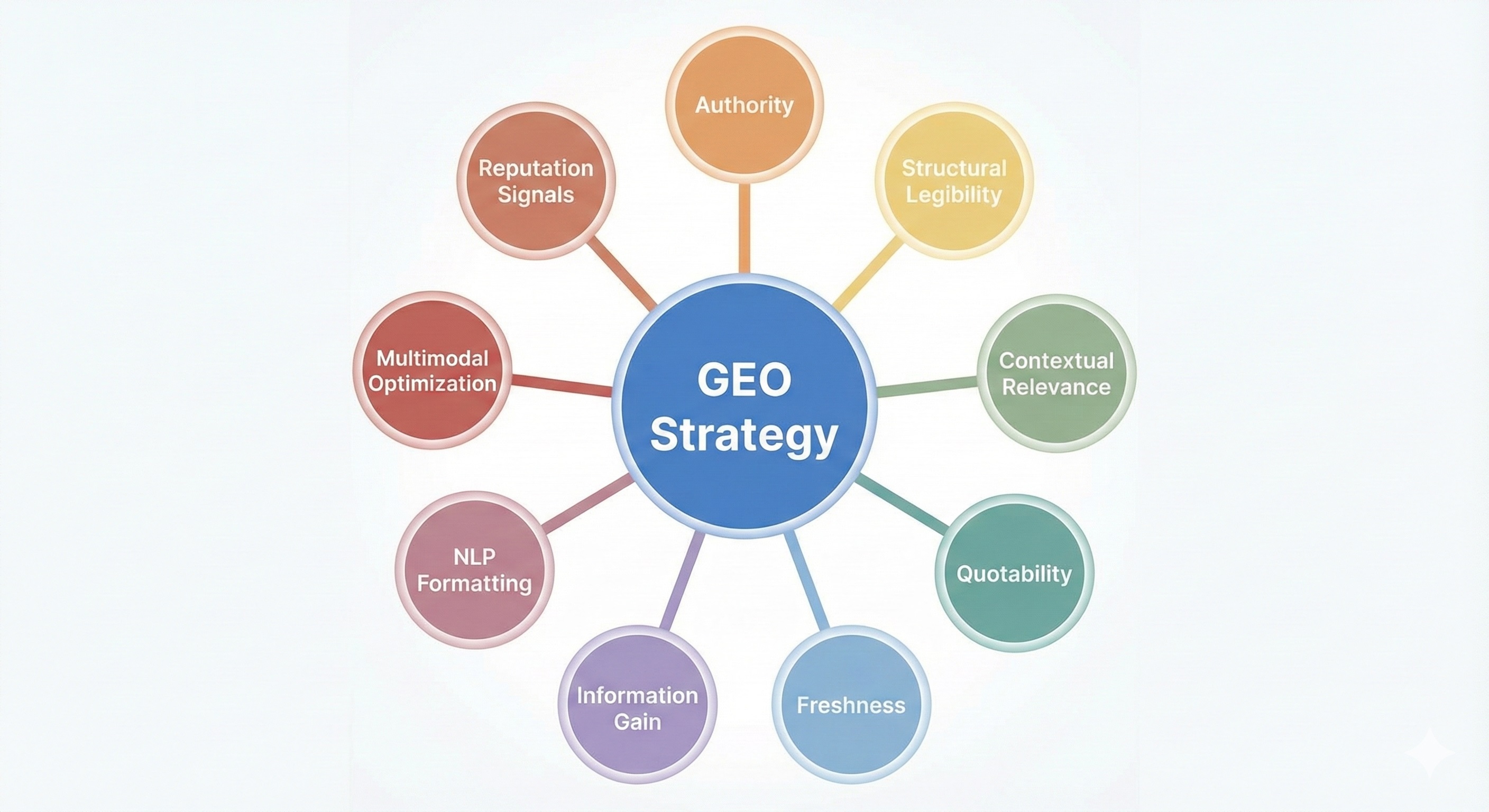
AI models are programmed to be risk-averse. When generating answers — especially for complex topics like finance, health, or enterprise tech — they rely on consensus. If your content makes a claim that isn't supported by other authoritative nodes in its training data, the model effectively "doubts" you.
The Nuance: It’s not just about having a high Domain Authority (DA). It’s about consistency. If your website claims you are a "leading expert in cloud security," but your LinkedIn profile, Crunchbase listing, and third-party reviews describe you as a "web design agency," the AI sees a data conflict and lowers its confidence score.
What This Looks Like: A medical article where the author is a verified MD, the content cites primary research papers (not other blogs), and the company’s "About" page matches its Wikipedia entry perfectly.
Humans read the rendered page (colors, fonts, layout); machines read the code. Generative engines process information fastest when it is delivered in a structured language they natively understand, like JSON-LD.
The Nuance: Unstructured text is ambiguous. If you write "Apple," the AI has to calculate probabilities to guess if you mean the fruit or the tech giant. Schema markup removes this calculation, explicitly telling the machine: "This entity is an Organization, not a Product."
What This Looks Like: Instead of just writing a recipe in a paragraph, the page uses Recipe schema to tag ingredients, cook time, and calories separately. The AI can then instantly extract "450 calories" to answer a user asking, "How many calories are in this dish?" without parsing the whole story.
Follow our guide to schema types for ecommerce GEO visibility for more information.
We've already mentioned this, but, considering the importance of this simple thing, here it is once again: GEO is built on entities (things), not keywords (strings). AI models use them to understand the world in a vector space — a mathematical map where related concepts sit close together.
The Nuance: If you write about a topic but fail to mention the "neighboring entities" that usually surround it, your content appears shallow or hallucinatory to the model. You cannot be an authority on "SEO" without also discussing "crawling," "indexing," and "backlinks."
What This Looks Like: A guide on "Marathon Training" that doesn't just discuss running, but naturally integrates related entities like "electrolyte balance," "VO2 max," "tapering," and "recovery footwear." The presence of these related concepts confirms deep expertise.
Large Language Models (LLMs) function as prediction engines. When they encounter a question, they look for text patterns that resemble a definitive answer. Long, winding introductions reduce the likelihood of extraction.
The Nuance: This is the "Inverted Pyramid" of GEO. AI prioritizes content that is syntactically simple but semantically dense. It prefers a direct definition followed by context, rather than context leading up to a definition.
What This Looks Like:
While LLMs have training cutoffs (dates past which they don't know new information), modern "Answer Engines" (like Perplexity or Bing Chat) browse the live web. They aggressively filter out "stale" data to avoid providing obsolete answers.
The Nuance: A date on a page isn't enough. The data points inside the content must be current. If your article is dated 2025 but references "Twitter" instead of "X," or quotes 2021 statistics, the model detects a temporal mismatch and downgrades the content's validity.
What This Looks Like: A financial guide that doesn't just explain "interest rates" generally, but explicitly cites the current Federal Reserve rate as of this month, signaling to the AI that this content is maintained and live.
Google and AI research teams have introduced the concept of Information Gain. This measures how much new information a source provides compared to what the model already knows.
The Nuance: If your article is a rewrite of the top 3 search results, your "Information Gain" score is near zero. AI models are designed to be efficient; they have no reason to cite a source that merely repeats the consensus. To be cited, you must add novelty to the dataset.
What This Looks Like: While everyone else defines "Conversion Rate Optimization," your brand publishes a study with proprietary data showing "The Average CRO Benchmarks for 2025." The specific, unique numbers make your content the primary source node.
"Perplexity" is a measurement of how surprised an AI model is by your text. High perplexity (confusing sentence structures, heavy jargon, erratic logic) makes it harder for the model to summarize your content accurately.
The Nuance: Writing for AI means reducing cognitive load. Simple logic connectors (brand X causes result Y) are easier to parse than complex metaphors.
What This Looks Like: Content that breaks dense paragraphs into bullet points, uses bold text for key concepts, and utilizes comparative tables (e.g., "Pros vs. Cons"). Tables are high-value targets for AI because the relationship between the data is visually defined.
Modern AI is not text-only. Models like GPT-4 and Gemini are multimodal. It means that they can "see" images, read charts, and analyze video transcripts.
The Nuance: A generic stock photo of a handshake adds zero value. However, a chart with labeled axes and clear data points is treated as "evidence." The AI uses Optical Character Recognition (OCR) to read the text inside your images to verify your claims.
What This Looks Like: Instead of writing "Our software is faster," you include a bar chart labeled "Speed Benchmark: Us vs. Competitors." The AI reads the chart and can cite: "According to their benchmark data, Brand X processes requests 2x faster."
Finally, AI understands your brand based on the company you keep. This is known as co-occurrence. The model analyzes how often your brand name appears alongside other authoritative words in your industry.
The Nuance: You don't always need a hyperlink (backlink) to benefit from this. If your brand is consistently mentioned in text alongside "Enterprise Security" or "Top Rated Solutions" on reputable third-party sites, the AI adjusts its internal weights to associate your brand with those qualities.
What This Looks Like: Being listed in a text-based "Best of 2025" roundup on a high-authority industry news site, even if the mention is unlinked. The semantic association trains the model to recommend you.
Understanding the theory is essential, but execution is what drives results. Learning how to build a geo strategy from scratch requires a shift in workflow, moving from keyword research tools to conversational testing and entity management.
Follow this three-phase roadmap to transform your brand from an "indexed page" to a "cited authority."
Focus: Assessing your current "Share of Model" across major AI engines.
Before you optimize, you must quantify your current standing. Unlike traditional SEO, where you track 10 blue links, GEO requires you to track mention frequency and sentiment.
Open ChatGPT, Claude, Gemini, and Perplexity. Enter the query a user would ask at the start of their journey, without mentioning your name.
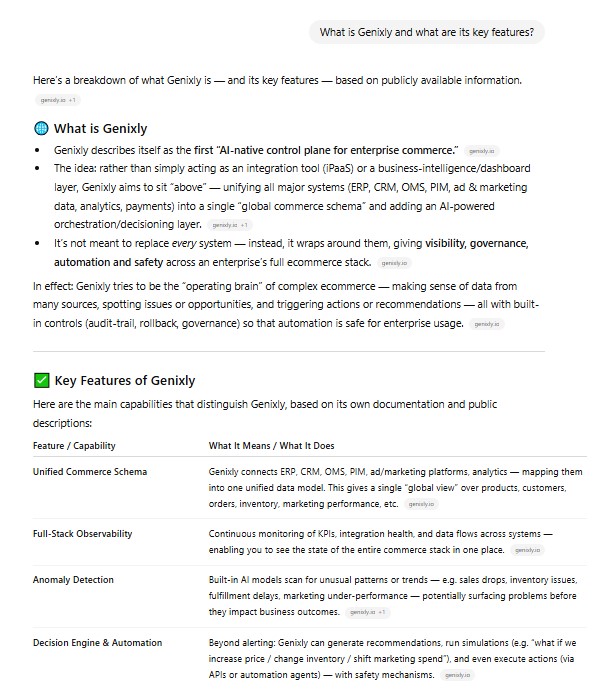
Ask the AI to define you. This reveals how the model interprets your entity.
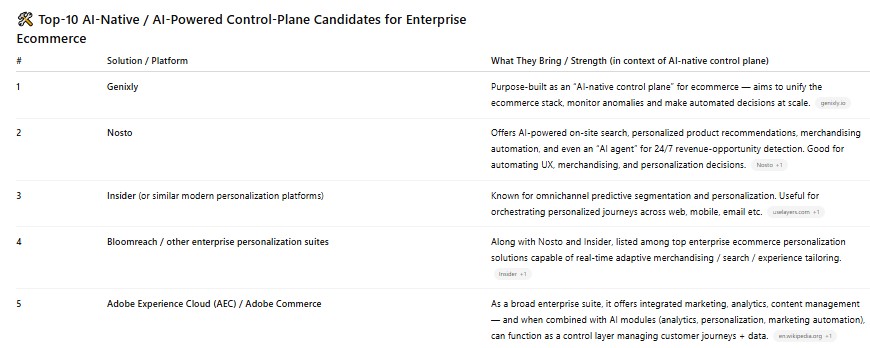
AI models are often used for direct comparisons.
Focus: Organizing structured data to disambiguate your brand.
Once you know where you stand, you must fix the foundation. You need to tell the AI exactly who you are using its own language: Entities.
Designate one page on your site (usually the "About" or "Home" page) as the single source of truth for your brand entity.
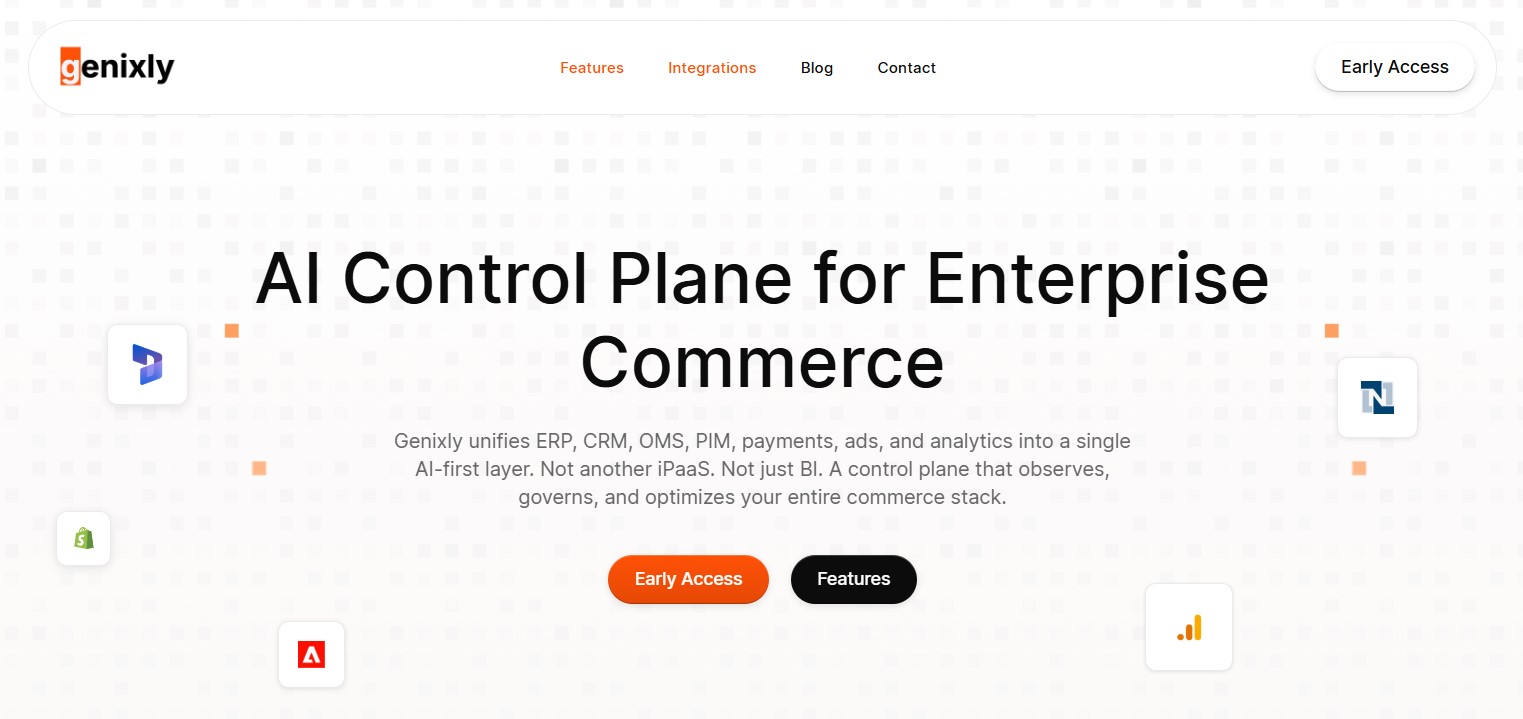
Action: Ensure this page clearly states your Organization Name, Founder, Headquarters, and Core Offerings in plain text.
It is vital from the perspective of a successful GEO strategy due to a couple of reasons:
SameAs" Schema This is the most critical technical step in GEO. You must connect your website to your other digital footprints so the AI knows they are all the same entity.
Action: Add SameAs markup to your Organization schema (see the example below). Link to your Wikipedia page (if applicable), LinkedIn, Crunchbase, Twitter, and authoritative third-party profiles. You can use this example markup, adding your company data:
<script type="application/ld+json">
{
  "@context": "https://schema.org",
  "@type": "Organization",
  "name": "Your Brand Name",
  "url": "https://www.yourdomain.com",
  "logo": "https://www.yourdomain.com/logo.png",
  "sameAs": [
    "https://www.linkedin.com/company/your-brand",
    "https://twitter.com/yourbrand",
    "https://www.crunchbase.com/organization/your-brand",
    "https://en.wikipedia.org/wiki/Your_Brand",
    "https://www.facebook.com/yourbrand",
    "https://www.instagram.com/yourbrand"
  ],
  "contactPoint": {
    "@type": "ContactPoint",
    "telephone": "+1-800-555-0199",
    "contactType": "Customer Service"
  }
}
</script>
This matters for GEO primarily because of these two aspects:
If you sell "Cloud Storage," ensure you aren't confused with "Weather Clouds."
Action: Use the Product schema (see the example below) that links to the specific Wikipedia ID for the concept of your service. This anchors your product to a universally understood definition in the Knowledge Graph.
<script type="application/ld+json">
{
  "@context": "https://schema.org/",
  "@type": "Product",
  "name": "Your Product Name",
  "description": "Your product description",
  "brand": {
    "@type": "Brand",
    "name": "Your Brand Name"
  },
  "additionalType": "https://en.wikipedia.org/wiki/Your_topic",
  "category": "Your Category",
  "offers": {
    "@type": "Offer",
    "priceCurrency": "USD",
    "price": "99.00",
    "availability": "https://schema.org/InStock"
  }
}
</script>
Here is why this matters for your GEO strategy:
additionalType Field: This is the most powerful line in the code. By linking to https://en.wikipedia.org/wiki/Cloud_computing, you are telling the AI: "Do not guess what this product is. It is an instance of the concept defined on this specific Wikipedia page."Focus: Restructuring content formats to maximize extraction rates.
Your content might be high-quality, but is it legible to a machine? AI models favor content that reduces their processing load. You must rewrite key pages to fit the "Answer Engine" format.
AI models prioritize content that is easy to navigate and summarize. If the model has to read 2,000 words to find the main point, it may time out or lose context. You must provide the "map" and the "answer key" upfront.
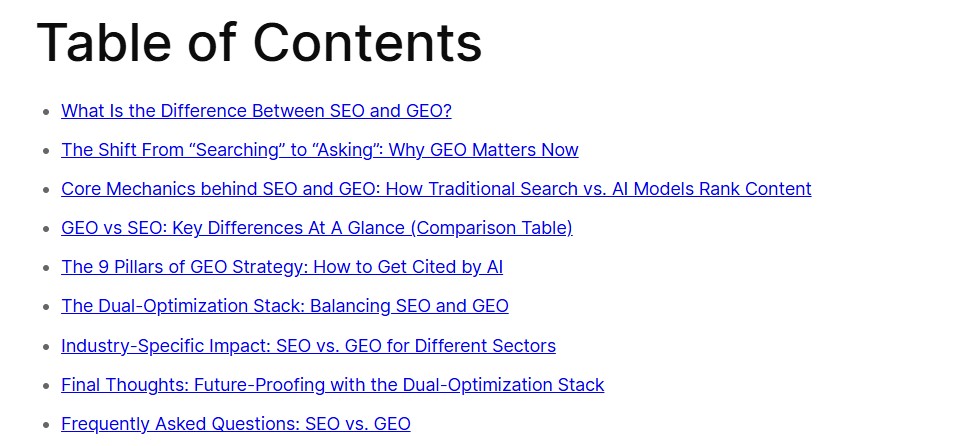
These two actions alone provide a notable impact on the success of your GEO strategy because of the following factors:
Unstructured text is the enemy of comparison. If you bury your pricing or feature specs in a paragraph, the AI has to perform complex linguistic parsing to figure out which number belongs to which plan. Tables, however, are treated as native data structures.
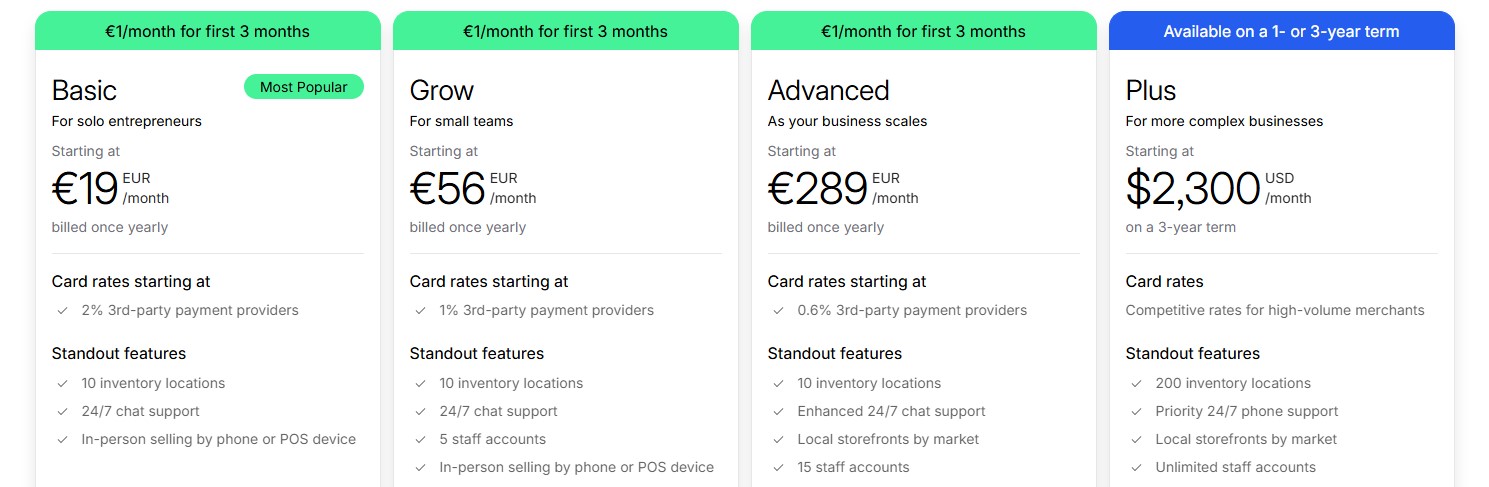
Consider this example:
Tables are vital for your GEO strategy success because they offer:
AI models struggle with abstract marketing copy. "Unlocking Potential" could mean anything from software updates to a yoga retreat. To be cited, your headers must function as labels that explicitly tell the model what information is contained in the paragraph below.
Just compare these two options:

That’s why this matters for GEO:
Now, follow this link to learn How to Measure GEO Success in Ecommerce.
Now, let’s say a few words about a GEO strategy from the enterprise perspective. For global organizations, the biggest risk in the AI era isn't low traffic — it's data fragmentation. Enterprise brands operate in an environment where every product division, regional office, and marketing campaign produces its own data signals.
In a traditional search world, a contradictory PDF buried on a microsite didn't matter. In an AI GEO strategy, that PDF is training data.
If an AI model encounters conflicting pricing in Europe versus the US, or outdated specs on a support sub-domain, it treats your brand as "low confidence." It doesn't know which fact is true, so it often chooses to cite a competitor whose data is cleaner. A successful geo strategy for enterprise brands turns your vast content footprint from a liability into a "Knowledge Graph" that models can trust.
When a user asks ChatGPT, "Which enterprise ERP is the most reliable?", the answer is not retrieved from a single database row. It is a probabilistic synthesis of every digital signal associated with your entity.
For large brands, reputation is a weighted average of your entire digital history.
The Enterprise GEO Solution: You must implement Digital Hygiene Protocols. This involves active "pruning" and "canonicalization" of legacy content.
Enterprise brands often suffer from Corporate Silos, where the sales team, the product team, and the support team describe the same feature in three different ways. Having three (in fact, you deal with more than three) unaligned sources of information generates dirty data. Dirty data, in turn, not only negatively affects your GEO strategy but also completely drowns your attempts to build an integrated commerce suitable for the implementation of AI-native solutions. But let’s focus on GEO.
In a generative environment, inconsistency creates hallucination. If your UK site describes a product as "Enterprise AI" and your US site calls it "Machine Learning at Scale," the model splits the vote. It struggles to reconcile these into a single, strong entity. To learn more about other GEO issues, follow this guide: 12 Common GEO Mistakes to Avoid in the AI Era.
Consistency is a Structural Asset. To strengthen your AI GEO strategy, you must unify your entity attributes across all channels:
In crowded enterprise markets (like SaaS, FinTech, or Logistics), brands often sound identical. They all claim to be "scalable," "secure," and "innovative." And guess what? AI models struggle to differentiate between generic claims.
The solution is building a Data Moat.
How to structure your proprietary data for AI:
The Strategic Takeaway: Competitors can copy your marketing copy, but they cannot copy your data. By publishing your internal telemetry, performance benchmarks, and industry research as structured, machine-readable assets, you anchor the AI's understanding of the market to your numbers.
So, why can you not ignore GEO today? Here is the short answer:
In traditional SEO, dropping from Rank #1 to Rank #5 means a 10% dip in traffic. In GEO, dropping out of the top citation spot often means 100% invisibility.
The cost of inaction isn't a slow decline; it is an immediate loss of market access. But everything is not so simple.
When a user asks a generative engine a complex question, the model provides a list of results, as we’ve described above, or it can reduce the answer to a single option. The AI performs a synthesized recommendation, choosing the "winner" and explaining why.
And that’s exactly where the binary visibility problem can kick your brand out of the proposed results. If your data is fragmented, unstructured, or ambiguous — you haven’t yet started planning your GEO strategy — you don’t simply rank lower. You are excluded from the calculation entirely.
In traditional SEO, rankings are fluid. You can lose the #1 spot on Tuesday and win it back on Friday with a few good backlinks. In the world of AI, the early adopter benefit works differently. It functions more like "wet cement."
The Early Adopter Benefit in GEO is the opportunity to establish your brand as a foundational fact in an AI model’s Knowledge Graph before the "cement dries."
When a new topic or niche emerges, AI models are hungry for structured, high-confidence data to understand it. The brands with a GEO strategy that can provide that structure first often become the "Semantic Default" for that category.
By adopting GEO now, you aren't just optimizing for the model; you are effectively training it. You define the terminology, the benchmarks, and the "best practices" that the AI will use to judge everyone else who comes later.
By waiting, you force yourself into a defensive position where you are always being compared to the leader, rather than being the leader.
The biggest threat of ignoring a GEO strategy is economic. While you can still rely on SEO only, GEO provides a very unique opportunity to target the bottom of the funnel — the highest-value queries closest to purchase.
Users now use AI to skip the research phase and jump straight to the decision:
These are not browsing queries; they are buying queries. If your brand is absent from these AI-led recommendations, the financial damage is threefold:
Follow this link to learn why GEO is important.
We are witnessing the end of the "keyword era" and the beginning of the AI-native era. As we explored in the 9 Pillars of GEO, visibility is no longer about convincing a user to click a blue link; it is about convincing a probabilistic model to cite you as the "Ground Truth".
The shift is fundamental:
The cost of ignoring this shift is not just lower traffic — it is binary invisibility. In an environment where AI synthesizes answers into a single recommendation, there is no "Page 2." You are either the answer or you are absent.
However, for enterprise brands, this challenge is also an unprecedented opportunity. The early adopter benefit in GEO acts like "wet cement". By structuring your data now — before your competitors do — you define the semantic rules of your industry, training the AI to view your brand as the default authority for years to come.
A successful GEO strategy requires more than just optimized content; it requires a fundamental restructuring of your data infrastructure.
Genixly provides the Unified Commerce Schema necessary to turn this strategy into an operational reality. We go beyond basic GEO implementation to connect your ERP, CRM, OMS, PIM, advertising data, and analytics into one global stack with unified data and a single source of truth. This creates a true AI-native control plane for enterprise commerce, ensuring full-stack visibility and verifying that every signal your brand sends — from inventory levels to customer sentiment — is structured, consistent, and ready to power the answer.
[Contact Genixly to Audit Your Entity Graph]
Our blog offers valuable information on financial management, industry trends, and how to make the most of our platform.