Genixly team
-
April 9, 2026
Co‑Mention Networks in GEO Explained: Your Guide to Shaping AI Category Memory
Lear more

Stop searching, start asking. Discover the best GEO tools for ecommerce to optimize your data for ChatGPT, Perplexity, and internal AI product discovery.



The era of the “10 blue links” is ending as AI is rewriting how shoppers discover products. Brands that adapt first will win. That’s why understanding the best GEO tools for ecommerce is no longer optional.
As Answer Engines like ChatGPT, Perplexity, and Google’s AI Overviews replace traditional search, visibility now depends on whether AI can interpret your catalog, not just index it. Why? Because users aren’t searching with keywords anymore. They’re asking specific questions and expecting a single, confident answer. And you need to be prepared for this great ecommerce shift.
This guide goes beyond tool lists. It shows you how to fix your data foundation manually, which best GEO tools for ecommerce help you get cited by AI, and which internal discovery systems ensure those visitors convert once they land on your site.
For the past two decades, ecommerce visibility depended on a single, repetitive ritual: users typing keywords into a search bar and scanning a list of "10 blue links." That era is ending.
We are witnessing the decline of the traditional search engine results page (SERP) and the rise of Answer Engines. Platforms like Perplexity, ChatGPT, and Google’s AI Overviews are fundamentally rewriting the growing role of AI in product discovery. Users aren’t searching in the classical sense anymore — they are asking.
Legacy search was literal. If a shopper wanted a dress, they typed "red dress" and manually filtered through 40 pages of results. This was a "fetch" mechanism.
AI-powered product discovery changes this dynamic by allowing users to input complex, intent-heavy prompts rather than fragmented keywords. Consider the difference in the user path:

This is not a query; it is a task.
Tasks require reasoning, synthesis, ranking, and decision-making. To survive this shift, merchants must evolve beyond simple keyword matching. This urgent need for adaptation is where geo for ecommerce websites emerges as a critical discipline.
Fundamentally, GEO is the practice of optimizing content so it is "native" to Artificial Intelligence. It shifts the focus from merely displaying text for humans to providing structured, machine-understandable data. This allows AI models to parse your inventory, understand the context, and answer these complex user tasks directly.
Why does this matter for your bottom line? Because AI collapses the "messy middle" of the marketing funnel.
In the traditional model, brands relied on users bouncing between category pages, third-party reviews, and comparison sites. Now, the AI agent acts as the synthesizer. It scans that information instantly and presents a single, authoritative answer.
This creates a "Winner Take All" environment where:
This shift requires a completely new toolkit. We are moving away from traditional metrics — like simple keyword rankings and click-through rates — and toward a new standard based on brand citations and answer visibility. This evolution creates a sharp contrast in GEO vs SEO performance:
This is why AI in ecommerce product discovery is no longer optional — it is the primary interface between your inventory and the shopper.
Learn why GEO becomes increasingly important in the era of AI search when old SEO tactics begin to fail: Duplicate Content, GEO, and Ecommerce Visibility.
For online retailers, however, GEO is not just about "better SEO." It is the strategic practice of translating your product catalog from a format designed for human eyeballs (HTML and images) into a format designed for machine reasoning (Structured Data, Knowledge Graphs, and Entities).
To understand why geo for ecommerce sites requires a different approach, you must understand how the "customer" has changed.
A traditional search engine (Googlebot) is an indexer; it stores your page. An AI model (LLM) is a probability engine; it predicts the next best answer. When an AI hesitates to recommend your product, it isn't because it can't find it — it’s because it lacks the statistical confidence to cite it.
Therefore, the primary goal of geo for ecommerce is to reduce ambiguity. You are no longer optimizing for "relevance"; you are optimizing for certainty.
So, the mental shift is simple: Stop treating your website as a digital catalog and start treating it as a structured dataset.
Follow this link to discover more about why GEO is important.
There is a dangerous misconception in the industry: that you can simply buy the best geo tools for ecommerce, plug them in, and instantly rank in ChatGPT.
This is false. GEO is not a plugin; it is a data standard.
If your underlying product data is messy, unstructured, or contradictory, adding AI tools will only automate chaos. Before you invest in software, you must ensure your geo for an ecommerce site is linguistically ready for machines. This requires a shift from "Visual Merchandising" (what looks good to humans) to "Semantic Readiness" (what makes sense to logic models).
Most ecommerce catalogs suffer from "Attribute Rot" — years of inconsistent tagging, duplicate values, and vague descriptions caused by the lack of data integrity in ecommerce. AI models hate ambiguity. They hate dirty data. Therefore, to prepare for AI-powered product discovery, you must audit your data for three specific "deal-breakers":
E-E-A-T stands for Experience, Expertise, Authority, and Trust. It’s a framework used by search engines — and now AI systems — to decide whether they should trust a brand.
Here’s the simplest way to think about it:
In GEO terms, E-E-A-T is simply how an AI decides “Should I recommend this brand?”
When an AI analyzes your brand to answer a prompt like "What is the safest non-toxic cookware?", it looks for data points that act as "Digital Proof." You need to translate your brand's reputation into structured data fields:
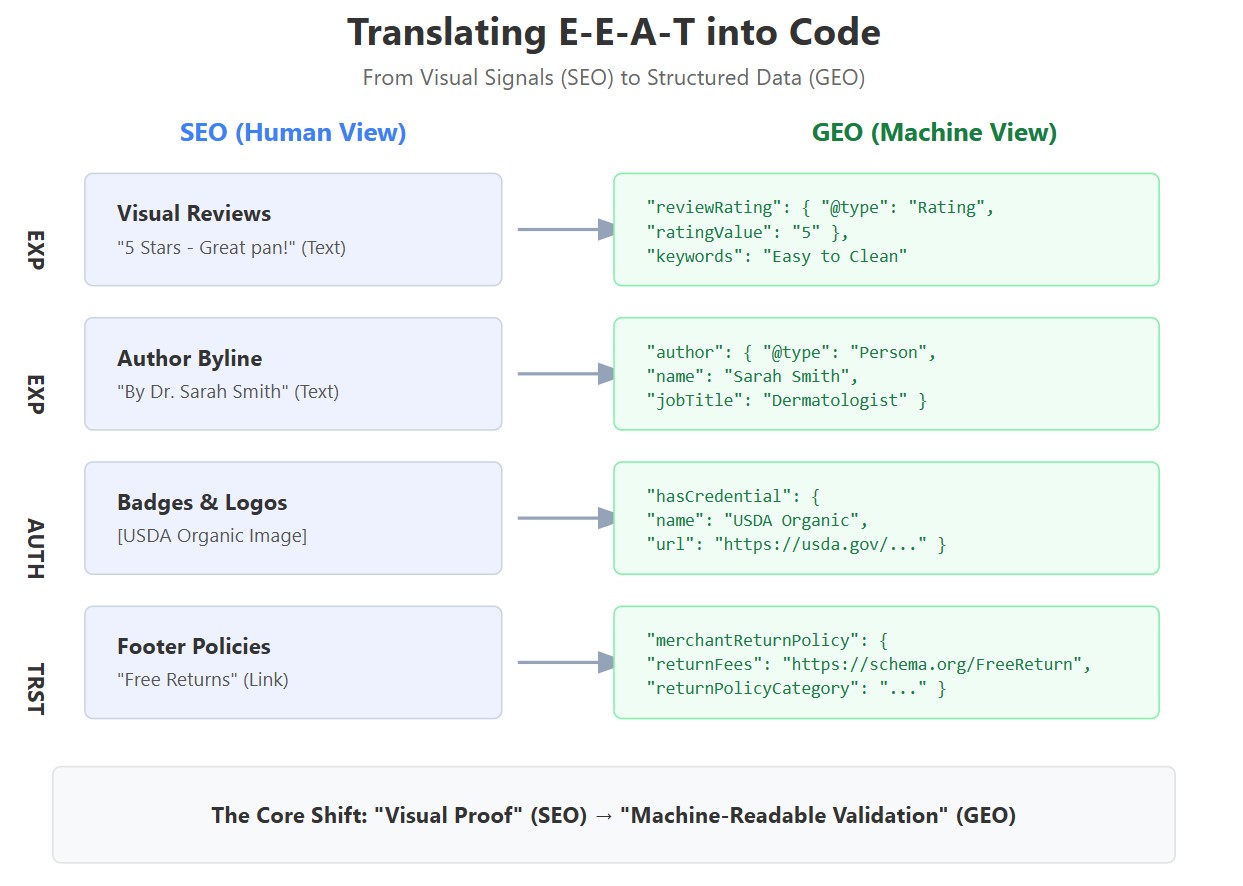
Finally, before selecting tools, you must identify what your data is missing.
Legacy catalogs answer "What is it?" (e.g., A Running Shoe). AI in ecommerce product discovery demands to know "What is it for?"
You must audit your catalog for Contextual Attributes. If you sell a jacket, does your data explicitly state:
If this data exists only in your copywriter's head and not in your database fields, no GEO tool can help you. You must enrich your "Source of Truth" first.
The Golden Rule of GEO: AI cannot recommend what it cannot read. Clean, standardized, and context-rich data is the fuel; the tools are just the engine.
To learn more about other optimizations, follow this link: GEO Strategy Guide.
Now that you have established a clean data foundation, the next phase is External GEO: ensuring your products are cited, recommended, and prioritized by Answer Engines.
In the legacy web, you optimized for Google’s crawler. In the new GEO for ecommerce landscape, you optimize for the "inference layer" of models like GPT-4, Gemini, and Claude. This requires a new stack of software designed to monitor "Share of Model" and enforce entity relationships.
Here are the best geo tools for ecommerce specifically designed for this external visibility.
The "Rank Trackers" of the AI Era.
Traditional rank trackers (like Ahrefs or SEMrush) are blind to AI conversations. They track static links, not dynamic answers. If a user asks Perplexity, "What is the best running shoe for flat feet?", standard SEO tools cannot tell you if your brand was mentioned.
The following tools solve this by monitoring "Share of Recommendation" — the percentage of times an AI suggests your product for a specific intent:
Passionfruit Labs tracks how often your products appear in AI answers and why they do — or don’t — get recommended.
Profound provides multi-model GEO analytics across ChatGPT, Perplexity, Claude, Gemini, and other LLMs.
Peec.ai monitors how LLMs emotionally interpret your brand — fast shipping, reliability, quality, trust — and compares those perceptions against competitors.
Otterly.ai tracks the themes, categories, and prompts where AI systems mention — or ignore — your brand
The "Translators" for Machine Understanding.
As established, AI does not read pages; it processes entities. However, hard-coding Schema markup for 10,000 SKUs manually is impossible. These tools automate the translation of your catalog into the JSON-LD format that Answer Engines require.
Schema App converts every part of your product catalog — products, variants, categories, returns, availability — into clean, compliant JSON-LD that AI systems can parse without friction.
WordLift automatically identifies key entities in your catalog and connects them to broader concepts, creating a machine-readable vocabulary that sits directly on your site.
InLinks analyzes your catalog based on entities, not keywords, and creates automated internal links that reinforce conceptual relationships between your products and their underlying attributes.
The "Context Builders" for Intent Matching.
To win a recommendation for a query like "Find me a non-toxic sofa for a house with cats," your content must explicitly bridge the gap between "Material: Velvet" and "Benefit: Scratch Resistant." Semantic tools analyze your text to ensure it covers the "vector space" (the related concepts) that AI expects.
Clearscope analyzes the strongest-ranking content on the web — including AI-generated answers — and identifies every relevant concept, attribute, and descriptor your content is missing.
MarketMuse scores every piece of content on your site for expertise, depth, and subject authority, then generates a map of the topics and questions you haven’t covered yet.
Frase analyzes real user questions from People Also Ask, forums, Reddit threads, and Q&A platforms, then helps you structure content as direct, concise answers.
Follow these links to discover a more broad spectrum of instruments related to GEO:
When it comes to AI product discovery, most people imagine ChatGPT or Perplexity recommending products in a chat interface. But there is a second aspect that is just as important for your revenue: Internal Product Discovery.
This refers to the search, navigation, and merchandising systems living inside your own ecommerce site.
Even if you win the external GEO battle and answer engines send high-intent traffic to your store, your job isn't done. If a user lands on your site and the internal search bar cannot understand their natural language query, they will bounce. To prevent this, AI tools for product discovery are replacing legacy keyword-matching engines with systems that understand intent, context, and semantics.
Think of this as the internal counterpart to the best GEO tools for product discovery, ensuring that once a customer arrives, they find exactly what they need without friction.
Modern shoppers have stopped "keyword stuffing" their own searches. They no longer type robotic queries like "mens jacket waterproof black." Instead, they type (or speak) natural language prompts like:
Traditional search engines fail here because they look for exact text matches. If the product description says "Gown" and the user searches "Dress," a legacy engine returns zero results.
AI-powered product discovery engines solve this using Semantic Search and Vector Embeddings. They don't match words; they match meanings. They understand that "running gear" is semantically related to "joggers," "sneakers," and "activewear," delivering results based on user intent rather than syntax.
Leading this category are platforms like Bloomreach, which dominate the enterprise space by combining semantic search with AI-driven merchandising that balances relevance with inventory profitability. Similarly, Algolia NeuralSearch offers a hybrid approach, blending the speed of keyword matching with the intuition of AI to minimize "No Results" pages.
On the personalization front, tools like Nosto use behavioral AI to re-rank these search results in real-time. If a user has previously browsed luxury items, Nosto ensures premium products appear first in the search grid, creating a 1:1 dynamic storefront for every visitor.
These platforms close the loop between external AI visibility and internal conversion, ensuring that the high-quality traffic you gain from GEO actually translates into sales.
Many shoppers do not know the right words to describe what they want. But they know it when they see it. This is especially true in fashion, home décor, and furniture, where aesthetic nuances are hard to type.
This "vocabulary gap" is where visual and multimodal search becomes a critical pillar of AI in ecommerce product discovery.
Visual discovery tools allow users to upload a photo, screenshot, or inspiration image (from Pinterest, Instagram, or TikTok) and instantly find the closest matching products in your catalog. More advanced multimodal engines go a step further, allowing users to combine inputs, for example, uploading a picture of a blue couch and typing "but in emerald green" to refine the search.
ViSenze is a standout tool in this space, widely used by fashion retailers to detect product types, styles, and attributes from user-uploaded images instantly. Syte takes a similar approach but adds a layer of "Automated Product Tagging," scanning your product images to automatically generate structured attributes (like "V-neck," "Satin," or "Boho style") that improve your overall catalog data.
By implementing these tools, you capture the demand that text-based search misses, dramatically improving conversion rates for "I’ll know it when I see it" shopping journeys.
Now, follow this link to learn How to Measure GEO Success in Ecommerce with different tools and manually.
GEO is still early — and that’s exactly why it matters.
Most ecommerce brands haven’t yet realized that answer engines are quietly becoming the new product discovery layer. While competitors are still optimizing meta titles and rewriting category pages, the brands that invest in GEO today are building something far more valuable: a structural advantage baked into their data, identity, and catalog design.
This advantage compounds quickly:
In other words: GEO rewards early adopters disproportionately. The brands that move first become the ones answer engines trust — and once an AI system internalizes your product graph, it gets harder for competitors to displace you.
But even the best GEO tools for ecommerce alone won't get you there.
The first phase of GEO is manual: cleaning your attributes, normalizing values, tightening your product relationships, enriching your schema, and building a coherent knowledge graph. Only then should you choose the solutions for ecommerce GEO to scale and automate your visibility across AI ecosystems. Make sure your product data strategy is ready by reviewing how to get started with GEO.
GEO is not a “feature.” It’s infrastructure. And the brands that treat it that way will own the next generation of ecommerce traffic.
If you want to go further than plugins and tracking tools — if you want a true AI-native control plane for ecommerce — we can help. Genixly provides a unified architecture that doesn’t just optimize GEO but coordinates your product data, workflows, signals, and automations end-to-end. It’s the operating system that makes GEO, personalization, fulfillment intelligence, and agentic AI work together instead of living in silos.
If you’re serious about building an AI-native commerce stack, contact us now . We can help you build a control plane that makes your data trustworthy, your brand visible, and your operations intelligent — long before the rest of the market catches up.
Our blog offers valuable information on financial management, industry trends, and how to make the most of our platform.