Genixly team
-
November 26, 2025
Customer Support Automation Explained: From Simple Scripts to Smart AI & Intelligent Agents
Lear more

Why is GEO important in 2026? Ranking links is no longer enough. Discover why modern visibility depends on being understood by AI, not just found by Google.



Below, you will find a direct answer to a question that an increasing number of businesses are asking: “Why is GEO important?”
For the last two decades, the contract between businesses and search engines was simple: you optimize for keywords — they give you traffic. You fight for a spot in the top 10 blue links, and the user visits your site to learn more.
That contract is rapidly slipping away — like sand through your fingers.
With the rise of ChatGPT, Claude, Gemini, and AI Overviews, we are witnessing a fundamental shift from search engines (which retrieve links) to generative engines (which synthesize answers). Users no longer want a list of websites to research; they want a direct answer, a comparison table, or a specific recommendation.
This shift has birthed a new discipline: Generative Engine Optimization (GEO).
Unlike traditional SEO, which relies heavily on backlinks and keywords, GEO relies on Entities, Confidence Scores, and Citations.
In SEO, you optimize for keywords (text strings). In GEO, you optimize for Entities (Knowledge Graph nodes).
An "Entity" is a piece of information that helps an AI model distinguish between Apple (the fruit) and Apple (the technology giant). For a generative engine, your brand is not just a name; it is a distinct object in a vector space with specific attributes — industry, pricing model, location, and key features.
Confidence is the mathematical probability that a piece of information is factually correct.
Unlike Google Search, which might show conflicting results on Page 1 to let you decide, an AI model must synthesize a single answer. To avoid "hallucinating" (lying), the model assigns a confidence score to every claim it generates.
Citations in GEO are not just "backlinks" — they are "Grounding Sources."
In traditional SEO, a link from a random blog might pass "link juice." In GEO, the AI uses specific, high-authority domains (like Wikipedia, LinkedIn, G2, Crunchbase, or specialized industry journals) to "ground" its answers in reality.
What does it all mean?
In the old world, being on Page 2 of Google meant you got less traffic. In the new world of GEO, if you don't meet the confidence threshold, you aren't just ranked lower — you are invisible. Even good SEO is not equal to good GEO.
We are entering an era where the "Messy Middle" of search — the hours users spend clicking tabs, comparing prices, and reading reviews — is collapsing. AI agents are taking over this research burden.
This is the primary reason why GEO is becoming increasingly important: it solves the Binary Visibility Problem.
In traditional search, visibility was a gradient. You could be #1, #5, or #10. In generative search, visibility is binary. The AI either includes you in its synthesized answer, or it doesn't. There is no "Page 2" in a ChatGPT answer.
If an AI model has 65% confidence in your brand data and 85% confidence in your competitor, it won't show you "a little bit less." It will likely exclude you entirely to avoid hallucination.
By 2026, as AI models become the primary gatekeepers of information, falling below this confidence threshold will mean instant market invisibility, not just a gradual decline in traffic.
The "Messy Middle" is disappearing, so don't get left behind; start adapting your brand to the age of answers today with our guide on how to get started with GEO.
Many marketers mistakenly view GEO as a top-of-funnel brand awareness play. The data suggests the opposite. GEO is critical for the moments that matter most: the purchase decision.
According to recent data from Adobe, users arriving via Generative AI sources spend 32% more time on the site and are more likely to convert than traditional search traffic. Furthermore, Capgemini reports that 71% of consumers now want generated AI integrated directly into their purchasing experience, using it effectively as a 'curated shortlist' before they ever click a link
Still wondering, why is GEO important for revenue? Because modern users are skipping the research phase and asking AI to make decisions for them.
If your pricing page is unstructured or your security specs aren't clear to the AI, you simply won't appear in that table. This creates a "Confidence Tax" — a hidden cost where you lose conversions not because your product is inferior, but because the AI lacked the confidence to recommend it.
The bad news is that piads can no longer fully compensate for this, as they did with the traditional search. Users trust AI answers as "synthesized truth," whereas ads are viewed as paid interruptions. If you are missing from the organic AI answer, no amount of ad spend can buy back that credibility.
The impact of GEO on B2C purchases may seem obvious, rooted in the end user’s preference for speed, simplicity, and comfort. It’s easy to believe the B2B sector is insulated from these changes — but it isn’t.
While B2C purchases can be impulsive, B2B buying is analytical, constraints-based, and involves multiple stakeholders. How does AI align with these aspects, and why is GEO important for B2B specifically?
The short answer: Because B2B buyers are using AI to shortlist vendors before they ever talk to a sales rep.
Consider a procurement manager looking for "ISO 27001 certified cloud storage." The AI acts as a sophisticated filter. However, you face new risks as a provider of ISO 27001-certified cloud storage.
The AI filter will ignore your product if:
In this scenario, GEO acts as a vendor shortlisting infrastructure. Competitors who have optimized their "Knowledge Graph", ensuring their specs, certifications, and use cases are machine-readable, become the default recommendation.
In B2B, GEO isn't just about traffic; it's about being able to make the deal.
If you believe there is still time to wait and see how it unfolds, you’re mistaken — profoundly so. So, why is GEO important in 2026?
Long story short — the "Wet Cement" effect.
Right now, Large Language Models (LLMs) are still in their formative phase, actively learning how to interpret complex industry verticals. They rely on clear, structured, high-confidence data to build this understanding. The information you provide today does not just describe your brand; it trains the AI on how your entire category operates. This creates a critical window of strategic opportunity. We call it the early adopter advantage in GEO.
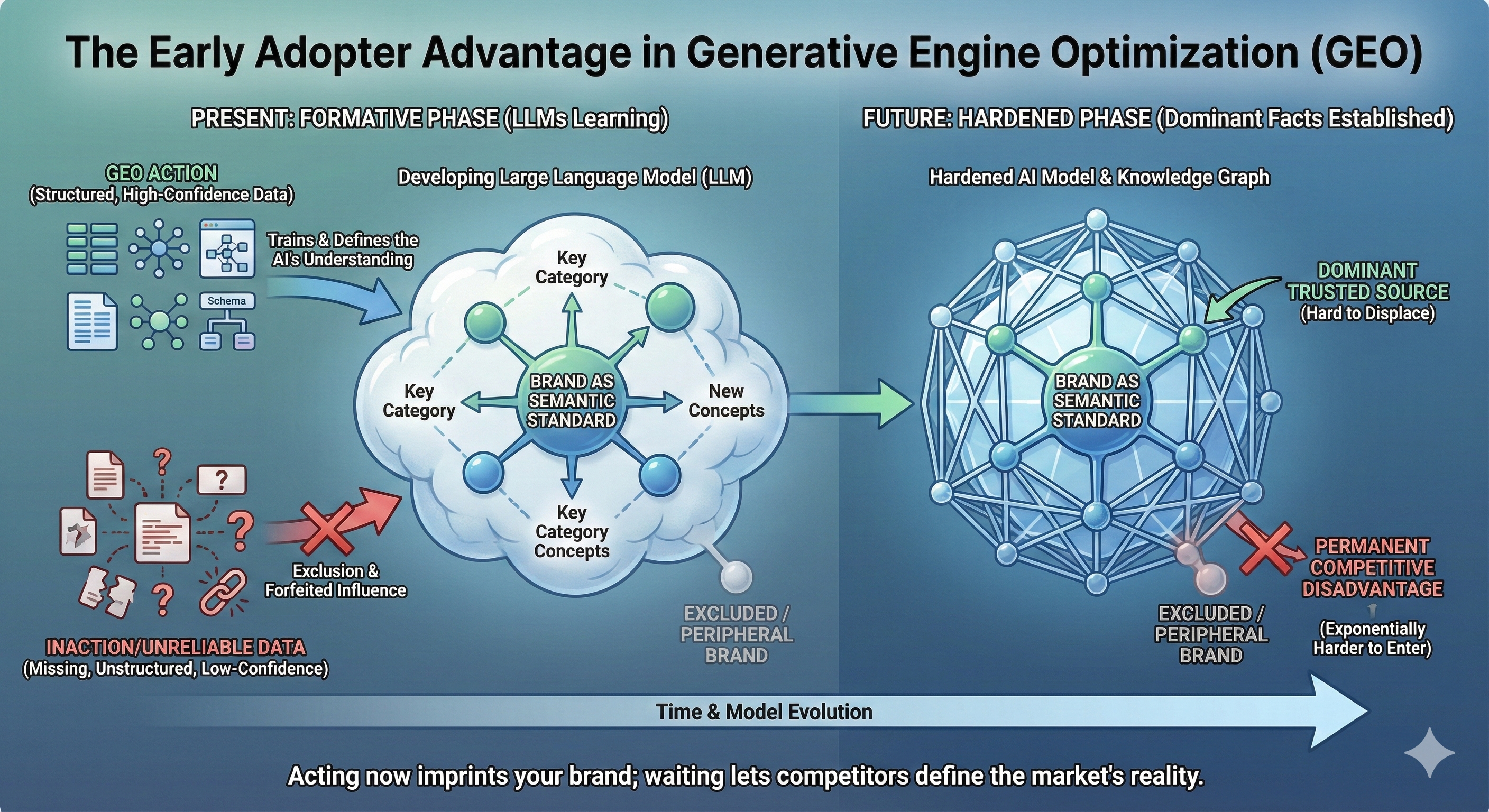
If your data is unreliable or inaccessible, the immediate cost is obvious: exclusion from current results. But the long-term cost is structural. By remaining silent now, you forfeit the ability to define how the model understands your market.
Once these systems 'harden' — establishing a dominant set of facts and trusted sources — displacing an entrenched competitor will become exponentially more difficult. Consequently, acting now allows you to imprint your brand onto the model, ensuring you are viewed not just as a participant but as the semantic standard for your industry.
We are witnessing the end of the "Messy Middle" of search. Users are no longer content with browsing; they demand synthesized decisions. This fundamental behavior change is the primary reason why GEO is becoming increasingly important.
In this landscape, visibility is binary. You are either a verified, high-confidence entity included in the AI's response, or you are invisible. If you close your eyes, this new paradigm won’t magically disappear. As we have seen, there is no "Page 2" in a ChatGPT answer, and no safe middle ground for ambiguous brands.
And no, traditional SEO tactics cannot fix this. Why is GEO important here? Because it focuses on inclusion rather than just ranking.
The winners in 2026 will not be the loudest marketers, but the most legible ones — companies that treat entity definition and citation presence as core infrastructure. Now, follow this link to learn How to Measure GEO Success in Ecommerce.
Waiting is no longer a neutral strategy. As models solidify their understanding of industries, early signals harden into long-term assumptions. The question is no longer if you should adapt, but whether you are prepared to let AI systems define your brand without your input.
Ready to secure your place in the AI future? Read the full GEO Strategy Guide to start building your defense today.
Our blog offers valuable information on financial management, industry trends, and how to make the most of our platform.